

Apoptosis Assays Market Size to Reach USD 6.30 Billion by 2034 from USD 3.13 Billion in 2026
The apoptosis assays market is growing at a 9.1% CAGR, driven by rising drug discovery, oncology research, and cell-based screening.
PUNE, MAHARASHTRA, INDIA, February 3, 2026 /EINPresswire.com/ -- The global apoptosis assays market was valued at USD 2.86 billion in 2025 and is projected to grow from USD 3.13 billion in 2026 to USD 6.30 billion by 2034, registering a CAGR of 9.1% during the forecast period.Apoptosis Assays Market Overview
Apoptosis assays are analytical tools used to detect and quantify programmed cell death, a critical biological process in cancer research, drug discovery, toxicology testing, and immunology studies. These assays enable researchers to evaluate cellular responses to therapeutic compounds and to study disease mechanisms at the molecular level.
Market growth is primarily supported by the rapid expansion of pharmaceutical and biotechnology research, increasing oncology drug pipelines, and rising use of cell-based assays in preclinical screening. Apoptosis assays are widely used to assess treatment efficacy, toxicity, and mechanism of action in both early- and late-stage drug development. The increasing complexity of drug candidates, including biologics and cell therapies, is further increasing demand for precise and reproducible apoptosis detection technologies.
Request a free sample PDF:-
https://www.fortunebusinessinsights.com/enquiry/request-sample-pdf/apoptosis-assays-market-115114
Market Segmentation
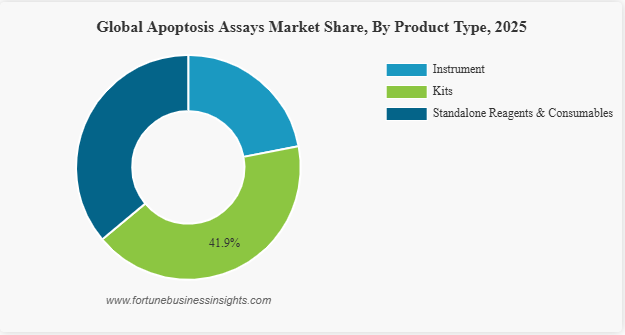
The apoptosis assays market is segmented by product type, assay type, detection technology, and end user. By product type, the market includes instruments, kits, and standalone reagents and consumables. Kits accounted for the largest revenue share in 2025 due to their standardized protocols, improved reproducibility, and ease of use in high-throughput laboratory environments. Standalone reagents and consumables are also witnessing strong growth, supported by recurring demand in routine research workflows.
By assay type, the market is segmented into caspase activation assays, annexin V–based assays, DNA fragmentation (TUNEL) assays, mitochondrial dysfunction assays, and other specialized formats. Caspase activation assays dominated the market in 2025 due to their widespread use as primary screening tools in drug discovery and toxicology studies. Annexin V–based assays are also gaining adoption for early apoptosis detection and multiparameter flow cytometry workflows.
Based on detection technology, the market includes flow cytometry, fluorescence microscopy, spectrophotometry, and other analytical platforms. Flow cytometry held the largest market share, supported by its ability to analyze heterogeneous cell populations and deliver high-content, multiparameter data. Fluorescence microscopy is gaining traction for imaging-based apoptosis analysis and spatial cellular characterization.
By end user, the market is segmented into pharmaceutical and biotechnology companies, academic and research institutes, hospitals and clinical research laboratories, and others. Pharmaceutical and biotechnology companies represented the largest end-user segment in 2025, driven by rising R&D investments, expanding oncology pipelines, and increased reliance on cell-based drug screening platforms.
Speack To Analyst:-
https://www.fortunebusinessinsights.com/enquiry/speak-to-analyst/apoptosis-assays-market-115114
Key Players
Thermo Fisher Scientific Inc. (U.S.)
Merck KGaA (Germany)
Danaher Corporation (U.S.)
Revvity (U.S.)
BD (Becton, Dickinson and Company) (U.S.)
Bio-Rad Laboratories, Inc. (U.S.)
Promega Corporation (U.S.)
Takara Bio Inc. (Japan)
Enzo Biochem Inc. (U.S.)
Biotium (U.S.)
Report Coverage
The report provides an in-depth analysis of the apoptosis assays market across major segments and regions. It covers market sizing, growth trends, competitive landscape, technology developments, and strategic initiatives by leading players. The study also evaluates regulatory environments, laboratory automation trends, and evolving research applications to provide a comprehensive assessment of market dynamics. The report includes regional and country-level analysis to support strategic decision-making for market participants.
Drivers and Restraints
Market Drivers
The primary growth driver is the expanding application of apoptosis assays in drug discovery, oncology research, and toxicology testing. Rising global cancer incidence and increasing funding for cancer research are significantly boosting demand for apoptosis-based screening tools. Pharmaceutical companies are increasingly adopting high-throughput apoptosis assays to accelerate lead identification and optimize drug safety profiles.
Additionally, growing adoption of cell and gene therapies is increasing the need for advanced apoptosis monitoring tools to evaluate treatment response and cellular viability. Workflow automation, cloud-based data analysis, and multiplexed assay formats are further enhancing laboratory efficiency and supporting market growth.
Market Restraints
High costs associated with advanced flow cytometers, fluorescence microscopes, and imaging-based systems remain a major barrier to market expansion. Instrument prices can range from tens of thousands to several hundred thousand dollars, limiting adoption among smaller laboratories and research institutions in emerging markets.
Data variability and protocol sensitivity also pose challenges, as apoptosis readouts can vary based on staining conditions, timing, and cell type. These issues increase the need for assay validation and standardization, raising operational complexity and slowing broader market penetration.
Regional Insights
North America dominated the apoptosis assays market, generating USD 1.02 billion in 2025, supported by strong NIH-funded research, high concentration of pharmaceutical companies, and advanced laboratory infrastructure. The U.S. remains the largest national market, driven by robust oncology research and biopharmaceutical innovation.
Europe represents the second-largest market, with steady growth driven by rising translational research, expanding clinical trials, and strong academic research activity in countries such as Germany, the U.K., and France.
Asia Pacific is emerging as a high-growth region, supported by increasing biotechnology investments, expanding pharmaceutical manufacturing, and rising government funding for life sciences research in China, Japan, and India. The region is expected to register one of the fastest growth rates over the forecast period.
Latin America and the Middle East & Africa are witnessing gradual growth, supported by improving research infrastructure and increasing government initiatives to strengthen biomedical research capabilities.
Key Industry Developments
August 2025: Revvity launched pHSense reagents to enable high-throughput apoptosis and internalization studies in drug discovery.
March 2024: Beckman Coulter introduced the CytoFLEX nano flow cytometer to support advanced apoptosis and small-particle analysis.
December 2023: Danaher completed the acquisition of Abcam plc to expand its apoptosis assay and reagent portfolio.
September 2022: BD launched BD Research Cloud to streamline flow cytometry and apoptosis assay workflows.
Related Reports:-
Protein Assays Market
Flow Cytometry Market
Ashwin Arora
Fortune Business Insights™ Pvt. Ltd.
+1 833-909-2966
sales@fortunebusinessinsights.com
Legal Disclaimer:
EIN Presswire provides this news content "as is" without warranty of any kind. We do not accept any responsibility or liability for the accuracy, content, images, videos, licenses, completeness, legality, or reliability of the information contained in this article. If you have any complaints or copyright issues related to this article, kindly contact the author above.
